SMT Line Configuration for EMS: A 2026 Equipment Checklist from Loader to Unloader
Diagnosis
Most SMT line purchases are made station by station, driven by the most visible bottleneck of the month. The result is a line with a fast mounter, an under-specified printer, a reflow oven short on zones, no buffer anywhere, and material handling done by hand. The line runs, so nobody calls it wrong. But utilisation sits in the sixties, changeovers take forty minutes, and every attempt to increase throughput just relocates the bottleneck one station downstream. A line is a queueing system, not a shopping list. Configure it as a system and the same capital buys meaningfully more output.
Station 1 — Magazine loader
Purpose: remove the operator who hand-feeds boards. Spec: magazine size matching your standard rack, cycle time under 8 seconds per board, SMEMA handshake, ESD-safe construction. Common mistake: buying the loader last, then discovering the line never runs unattended.
Station 2 — Solder paste printer
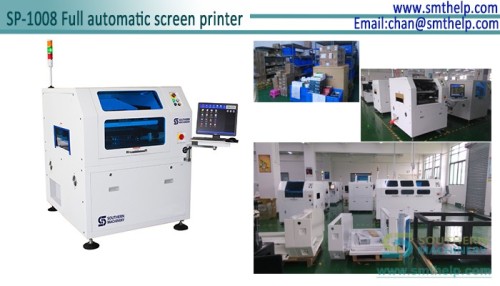
Purpose: decide your defect rate. Roughly 60% of SMT defects originate at the print stroke. Spec: vision alignment on board and stencil, programmable squeegee pressure and separation speed, automatic under-stencil wipe with dry/wet/vacuum modes, and alignment repeatability at or below ±0.025 mm. Common mistake: buying a printer that cannot hold tolerance on 0201 or 0.4 mm pitch, then blaming placement.
Station 3 — SPI (solder paste inspection)
Purpose: close the loop. Optional below roughly 500 ppm defect targets, mandatory below 200 ppm or on fine-pitch. Spec: measurement repeatability, closed-loop feedback to the printer, and SPC export. Common mistake: buying SPI without the closed-loop link, which produces data instead of correction.
Station 4 — Placement machine
Purpose: convert feeder capacity into placements. Spec the system, not the headline CPH: realistic CPH on your actual board mix (typically 55-70% of rated), feeder slots versus your bill of materials, component range from 0201 to BGA and odd-form, and changeover time with cassette exchange. Common mistake: buying rated CPH and discovering the board mix caps you far below it.
Station 5 — Reflow oven
Purpose: make the thermal profile repeatable across a full shift. Spec: 8 zones for most consumer and LED work, 10-12 for dense double-sided boards or heavy thermal mass, independent top and bottom control, mesh or rail conveyor, nitrogen capability if you run lead-free at volume, and flux recovery. Common mistake: under-specifying zones and then compensating with slower conveyor speed, which caps the whole line.
Station 6 — AOI
Purpose: catch defects while they are still cheap. Spec: post-reflow placement, programme library reuse, false-call rate under your operator tolerance. Common mistake: buying AOI and then staffing it as a manual review station, which converts a detection tool into a bottleneck.
Station 7 — Buffer and handling
Purpose: decouple stations so one stoppage does not stop the line. Spec: buffer capacity sized to your longest expected micro-stoppage, conveyors with SMEMA, and ESD compliance. Common mistake: zero buffers, which means every printer wipe stops the mounter and every mounter jam stops the oven.
Station 8 — Unloader
Purpose: close the loop on unattended running. Spec: matching magazine capacity, bypass mode for engineering runs, SMEMA. Common mistake: treating the unloader as optional and paying an operator to stand at the end of the line.
Station 9 — Material logistics
Purpose: keep reels flowing and scrap moving. Spec: intelligent reel storage with tracking, and scrap tape cutting at the mounter outlet. Common mistake: ignoring logistics entirely, then losing changeover minutes to reel hunting and housekeeping.
Our vehicle
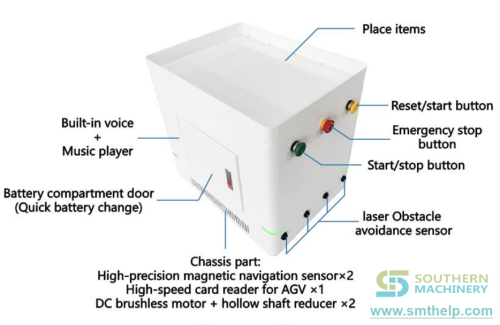
We supply both ends of this checklist and the logistics in between. On the front end: the SP-1008 and SP-830 automatic stencil printers, and the S-6600 lead-free reflow oven in 8, 10 or 12 zone configurations. On the back end: SLD250 loaders, SUL250 unloaders, the SFY03 magnetic AGV for magazine and pallet transport, the S-680A scrap tape cutter, and the ADL100 X-Ray component counter to keep kitting accurate. If you send us your board mix and target throughput, we will return a full line layout with station-by-station specifications and the utilisation model behind it.
The compounding loop
Re-run this checklist every time your board mix shifts materially, not when you are forced to by a crisis. The two numbers worth tracking monthly are line utilisation and changeover minutes. Both move slowly, both are visible if you log them, and together they tell you which of the nine stations is next in line for capital. Factories that review quarterly consistently spend less on emergency purchases and more on the station that actually constrains output.
Send us your top three board part numbers, monthly volumes and target CPH. We will return a complete SMT line configuration with layout drawing, station specifications and a utilisation estimate — no obligation, and no sales call required.
How many reflow zones do I actually need?
Eight zones cover most consumer electronics and LED work at moderate conveyor speeds. Move to 10 or 12 zones when you run dense double-sided boards, heavy thermal mass, or need higher throughput without raising peak temperature.
Do I need SPI on my SMT line?
SPI is not mandatory for every line, but it becomes necessary when your defect target drops below roughly 200 ppm or when you run fine-pitch components. To be worthwhile it must feed measurements back to the printer; standalone inspection produces data without correction.
What is a realistic CPH for a placement machine on a real board mix?
Plan on 55 to 70% of the rated CPH for mixed production. Rated figures are measured under ideal conditions with a single component type and optimal feeder layout. Your actual board mix, feeder changes and fiducial corrections determine the real number.
Should I automate material logistics from day one?
Start with the loaders and unloaders, which are a small fraction of capital and immediately enable unattended running. Add AGV logistics once your line count or travel distance makes manual magazine transport a measurable constraint.